 – CONTENUTO RISERVATO AGLI ABBONATI
The European Youth Think Tank (EYTT) is an independent organization dedicated to research and analysis on the major economic, geopolitical, and social transformations shaping the twenty-first century. Through an interdisciplinary approach, our goal is to contribute to public debate with forward-looking proposals. From this perspective, the future of Southern Italy represents one of the most strategic issues not only for Italy, but also for Europe as a whole.
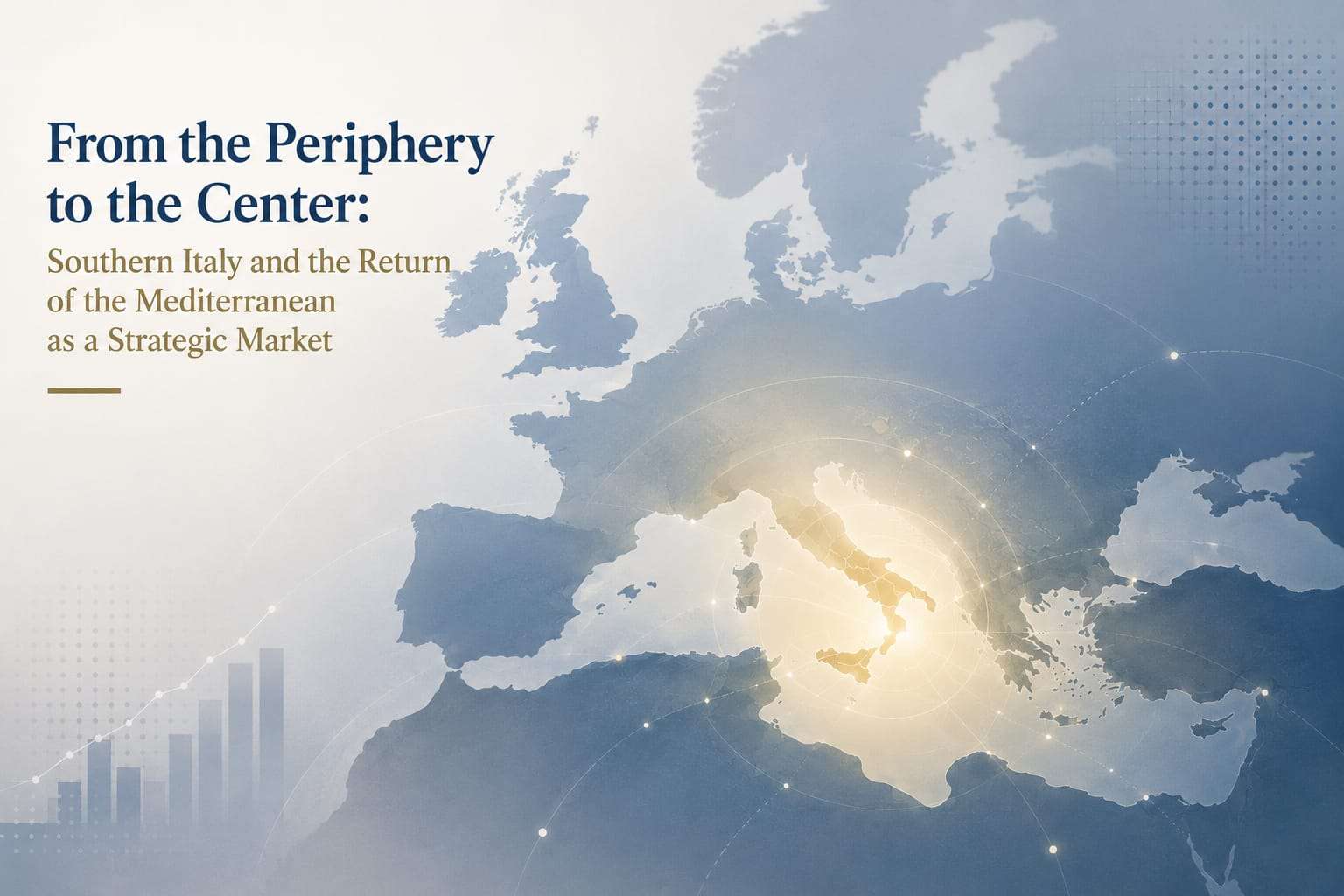
For decades, Southern Italy has been portrayed as an economic periphery, geographically distant from Europe’s main markets and constrained by its location. While this interpretation contains elements of truth, it risks overlooking the profound changes currently reshaping the Mediterranean. Armed conflicts, energy security, new trade routes, the green transition, and the reconfiguration of global value chains are transforming the geography of international economics. In this new context, Southern Italy has the opportunity to turn what was once considered a structural disadvantage into one of its greatest strategic assets.
Distance Still Matters, but Less Than Before
Over the past decades, Southern Italy has shown stronger economic performance than many observers had anticipated. One important explanation lies in the gradual reduction of distance-related costs.
Containerization, standardized logistics, e-commerce, business digitalization, and increasingly efficient transport systems have progressively reduced the economic burden of geographical distance. Today, even small firms located in Southern Italy can reach international markets through digital platforms far more easily than in the past.
Geography still matters. However, the cost of distance has declined considerably, creating new opportunities for territories historically perceived as peripheral.
This evolution is consistent with the findings presented in Theory of Commercial Gravitational Fields in Economics: The Case of Europe (2023), published in Networks and Spatial Economics. By applying gravitational models to European trade, we demonstrated that geographical distance continues to represent a significant resistance to economic exchange, while improvements in infrastructure and logistics progressively reshape trade flows. In other words, geography is not destiny. Its economic consequences depend on market integration and on the ability to reduce the costs associated with distance.
The Mediterranean as Southern Italy’s Natural Market
For more than seventy years, Italy’s economic development has largely been interpreted through the lens of continental European integration. This strategy has been extraordinarily successful, culminating in the creation of the European Single Market.
Yet the Mediterranean represents something fundamentally different.
Long before European integration, the Mediterranean was one of the world’s most dynamic economic spaces. Italian, Spanish, Greek, and North African port cities built their prosperity through centuries of commercial, financial, and cultural exchanges across this sea. Today, this historical dimension is returning under new conditions: energy interdependence, maritime security, migration governance, climate adaptation and industrial supply chains are making the Mediterranean central once again.
The European Union is one of the greatest political and institutional achievements of modern history. The Mediterranean, however, constitutes a naturally integrated economic space shaped by geography itself. Bank of Italy Governor Fabio Panetta has underlined that the Mezzogiorno is located at the crossroads of the Mediterranean, through which roughly one fifth of global maritime traffic passes.
Paradoxically, Southern Italy remains more deeply integrated into continental European economic circuits than with many economies located across the Mediterranean. If economic integration with North Africa and the Middle East strengthens over the coming decades, Southern Italy could emerge as Europe’s primary logistics, energy, and commercial platform connecting the EU with the broader Mediterranean region.
Mediterranean Stability as an Economic Policy
This perspective highlights an often underestimated issue.
Mediterranean stability is not merely a matter of foreign policy or international security. It is also a fundamental economic development policy for Southern Italy.
In our study Exploring Economic Conflict Through the Gravitational Field Model of Trade: Markets, Wars, and Instability (2025), published in Conflict Resolution Quarterly, we demonstrated how wars and geopolitical instability reshape the gravitational fields of international trade. Conflicts increase the economic costs of distance, discourage investment, disrupt supply chains, and significantly alter commercial flows.
Consequently, every crisis affecting the Mediterranean has economic consequences that extend far beyond the directly involved countries. It also reduces the growth potential of territories such as Southern Italy, which could benefit enormously from a stable, integrated, and economically open Mediterranean basin.
Promoting Euro-Mediterranean cooperation, therefore, is not only a geopolitical objective but also a long-term investment in the economic development of Southern Italy.
Energy, Infrastructure, and Comparative Advantages
The energy transition may represent the greatest economic opportunity for Southern Italy.
The European Commission’s Joint Research Centre, through PVGIS, provides solar-radiation and photovoltaic-performance data showing how electricity generation potential varies significantly by location; in this European geography, Southern Italy belongs to one of the continent’s most favourable solar areas.
Similarly, Southern Italy offers remarkable potential for wind energy and, in the future, for new Mediterranean energy infrastructures linked to green hydrogen and electricity interconnections with North Africa. The SoutH2 Corridor, for example, is designed to connect North Africa with Italy, Austria, and Germany, potentially transporting more than 4 million tonnes of hydrogen per year, and covering up to 40% of the EU’s 2030 hydrogen import target if fully realized.
This is not simply about producing more energy. It is about positioning Southern Italy as one of Europe’s future energy hubs.
Ports, Logistics, and the New Geography of Trade
The same reasoning applies to logistics. Ports such as Gioia Tauro, Augusta, Taranto, Bari, Naples, and Palermo constitute strategic assets whose importance is likely to increase as companies shorten supply chains, diversify production networks, and seek more resilient logistics systems.
However, infrastructure alone is not sufficient. Ports must be integrated with railways, intermodal terminals, digital infrastructure, Special Economic Zones, customs efficiency, and predictable administrative procedures to create a competitive logistics ecosystem. This is consistent with the European Union’s TEN-T policy, which aims to develop a coherent, efficient, multimodal and resilient transport infrastructure across the EU, linking ports, terminals, railways, roads, and urban nodes.
Within this broader strategy, even the Strait of Messina Bridge should not be evaluated merely as a symbolic political project, but as one component of a wider infrastructure vision. No single infrastructure can transform an economy by itself. Yet when integrated into a coherent transport and logistics system, it can significantly improve accessibility and competitiveness.
A New Strategic Role for Southern Italy
The twenty-first century may require us to rethink Southern Italy entirely. For decades, the South has been evaluated primarily according to its distance from Milan, Munich, or Paris.
Perhaps it is time to measure its proximity to Tunis, Algiers, Cairo, Alexandria, Athens, and the major commercial and energy corridors crossing the Mediterranean. Geographical position is never absolute. Its strategic value depends on the market through which it is interpreted. If continental Europe remains the only reference point, Southern Italy will continue to appear peripheral. If the Mediterranean once again becomes one of the world’s major economic spaces, Southern Italy could become one of Europe’s principal gateways toward North Africa and the Middle East.
Achieving this transformation requires a long-term political vision. It demands investment in infrastructure, universities, research, human capital, innovation, international cooperation, and regional stability. Roads, ports, bridges, and energy corridors can generate development only if they are supported by skills, firms, public services, institutional quality and social infrastructure.
The future of Southern Italy will not depend solely on its capacity for economic growth. It will depend on whether Italy and Europe recognize that the Mediterranean is no longer a peripheral strategic area.
It is gradually returning to the center of global economic competition. If this transformation continues, Southern Italy will no longer represent Europe’s geographical margin. It may instead become one of its most important strategic platforms for the decades ahead.